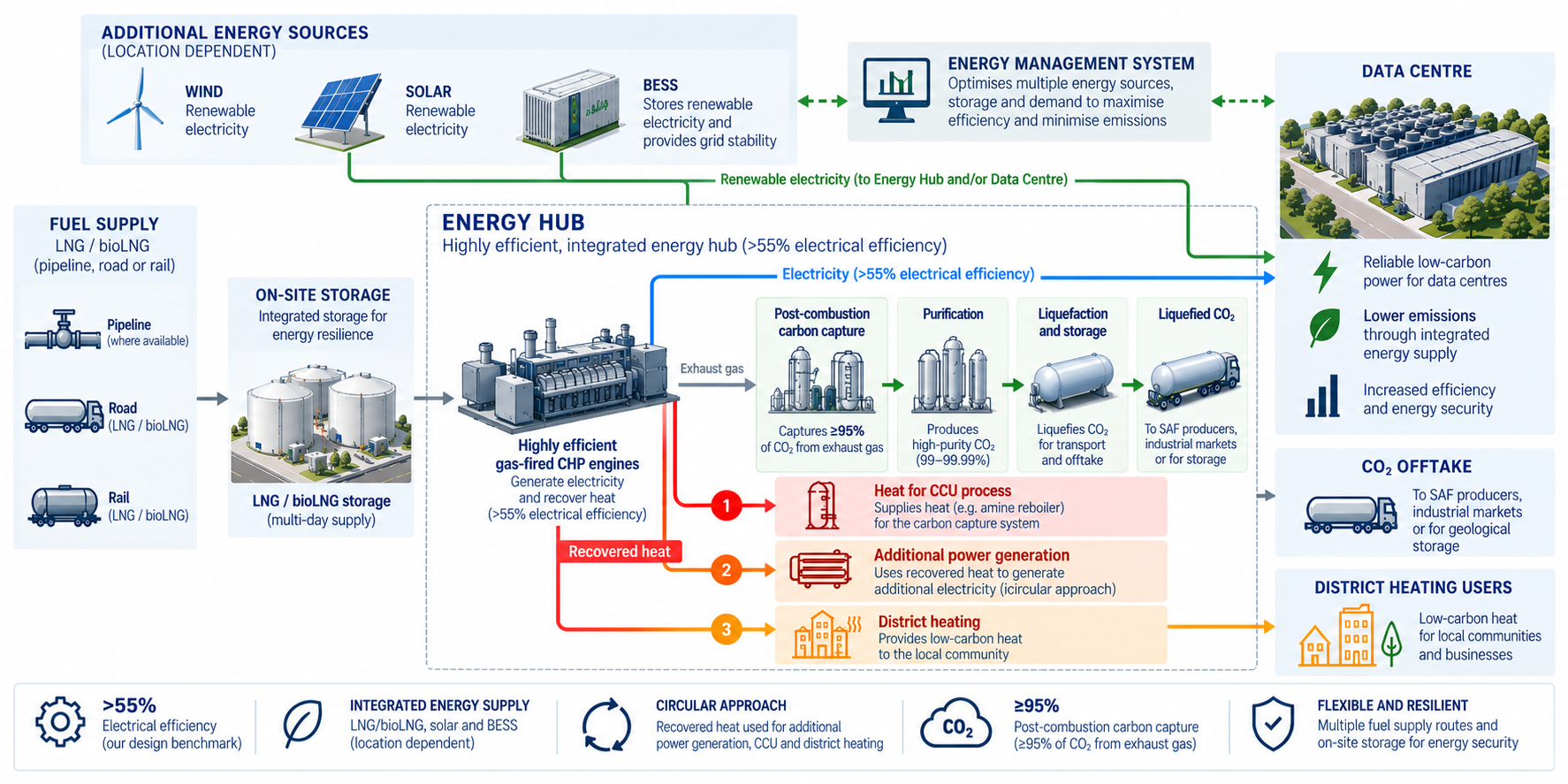
An integrated energy infrastructure platform built around data-centre demand. Power generation and post-combustion carbon capture remain at its core, complemented by heat recovery and other energy sources where the location supports them. Our circular economy approach aims to turn otherwise wasted resources into useful outputs and stronger investment performance.
Generation is located alongside, or connected directly to, a data-centre campus. The aim is to align dependable power capacity with customer demand and delivery programmes, enabling earlier campus operations where grid availability constrains development. For investors, the value lies in accelerating access to power while building a long-term, contract-led energy asset.
Our aim is to deliver power in 18–24 months from investment commitment to operation, enabling earlier campus operations where grid access would otherwise delay delivery. Timing depends on site readiness, planning and permits, equipment availability, fuel supply and agreed customer requirements.
Fuelled generating units produce electricity for the campus. The hub’s capacity, redundancy and operating strategy are designed around the customer’s load and reliability requirements. Fuel procurement, maintenance and connection arrangements are developed together.
02 / CAPTURE
Separate the CO₂
Post-combustion capture removes CO₂ from exhaust gas after fuel has been burned. The captured stream is then conditioned and purified to meet the requirements of its intended market, with liquefaction, storage and transport where required.
03 / RECOVER
Create additional value
Captured CO₂ can be supplied to suitable industrial users, including prospective synthetic SAF producers. Recoverable heat can serve local demand where technically and commercially viable. These routes complement the core power business.
Capture and CO₂ conditioning require energy. Investment appraisal therefore uses net electricity available to customers after the hub’s own consumption, alongside capture performance, operating costs and the economics of each offtake route.
The investment logic
Anchor demand. Diversify the revenue base.
Data-centre power is the foundation of the model. Collaboration with leading developers helps align capacity, investment timing and campus requirements. Additional offtake markets can reduce reliance on one revenue stream, subject to demand, contracts and delivery costs.
Power
Long-term power purchase agreements can underpin the investment case. Contract duration, customer credit quality, demand ramp-up and the allocation of fuel-price risk shape the quality of that revenue.
CO₂
Purified captured CO₂ offers a separate product and customer base. Its value depends on specification, eligible uses, contracted volumes, pricing and the cost of conditioning and logistics.
Heat
Recovered heat can provide an additional income stream where nearby users and suitable infrastructure exist. Appraisal accounts for demand, seasonal usage and the cost of making heat available.
Adapted to the location
A core concept. A flexible energy mix.
Each Energy Hub is designed around its location, available resources and customer needs. Power generation with post-combustion carbon capture remains the main concept. We also assess complementary energy sources and recovery technologies where they improve the overall technical, environmental and commercial case.
Heat to steam and power
Where heat temperature and available volumes are suitable, recovered heat can raise steam for useful processes or support additional electricity generation. Heat allocation is assessed across capture requirements, local customers and power recovery to find the most valuable use.
Renewable energy
Solar, wind and other renewable power can complement the hub where local resources, land and connections make them viable. Integration is designed around customer demand and reliable supply, with variable generation assessed alongside the core plant’s operating strategy.
Local opportunities
The energy mix reflects the site’s resources and nearby markets. Each addition is assessed for capital cost, operating performance and its contribution to net power delivery and long-term returns, rather than assuming the same configuration at every location.
Our circular economy approach
Reduce waste. Reuse resources. Create value.
We believe that more value can be created by treating useful by-products as resources. Our aim is to recover heat, develop productive uses for captured CO₂ and integrate complementary energy sources, reducing waste and making better use of the inputs each hub consumes.
Cleaner outcomes
Recovering useful energy and supporting suitable carbon utilisation routes can improve resource efficiency. Environmental performance is assessed across the whole system, including residual emissions, upstream impacts and the end use of captured CO₂.
Lower costs
Reusing heat within the hub and recovering additional useful energy can reduce purchased energy requirements and improve operating efficiency. The benefit is assessed after the cost and energy use of the recovery equipment.
Stronger returns
Power, CO₂ and usable heat can create multiple revenue streams from one integrated asset. Combined with potential operating savings, this approach aims to improve margins and investor returns, where customer demand and project economics support it.
Aviation and the carbon value chain
Connecting power infrastructure with future fuel markets.
BridgePower is establishing partnerships with SAF producers to explore high-purity captured CO₂ as a feedstock for synthetic aviation fuels. CO₂ is one input: fuel production also requires hydrogen, energy and processing infrastructure provided within the producer’s value chain.
Our strategy supports the direction of ReFuelEU Aviation. Each opportunity is assessed against carbon-source eligibility, producer specifications and applicable lifecycle emissions requirements. Capture alone does not make a fuel eligible, and carbon utilisation does not necessarily constitute permanent storage.
This creates a potential additional route to market for the hub’s CO₂, alongside other suitable uses. We assess offtake economics and eligibility before incorporating revenues into an investment case.
Disciplined development and operation
Manage the whole system.
Commercial alignment
Assess power demand, customer credit, fuel supply and CO₂ and heat offtake together. Contract structures and downside scenarios help test the resilience of project cash flows.
Delivery and reliability
Coordinate land, permits, connections, construction and commissioning. Design redundancy and maintenance around customer requirements, with clear performance obligations and operating responsibilities.
Measured performance
Monitor net power delivery, availability, capture performance and offtake quality. Appraisal includes fuel and upstream emissions, residual emissions, capture energy use and the final destination of CO₂.
BridgePower brings investment, development, asset and platform management together across this lifecycle. Our objective is dependable operations and diversified income, with risks assessed and managed at both project and platform level.